1. The Fundamental Cause: Obliquity of the Ecliptic
Earth does not orbit the Sun perpendicular to its orbital plane. Instead, its rotational axis is tilted by approximately 23.44° relative to its orbital plane (the ecliptic). During the Northern Hemisphere summer, the North Pole tilts directly toward the Sun.
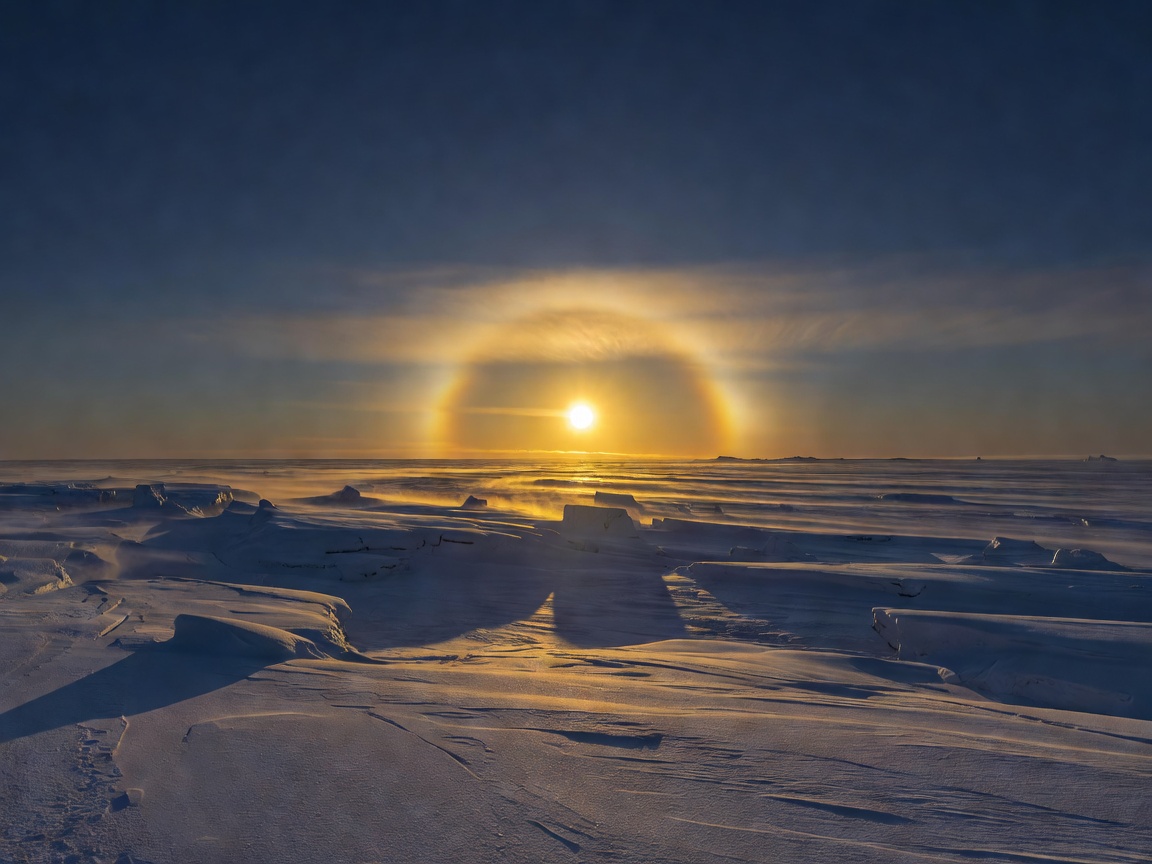
At latitudes above 66.56° N, Earth's daily 360° rotation cannot carry an observer into the shadow cone (nightside) of the planet. Instead, the observer remains continuously exposed to direct solar radiation for at least one full 24-hour cycle on the June Solstice.
2. Atmospheric Refraction: The 34-Arcminute Visual Lift
If Earth lacked an atmosphere, the boundary of the Midnight Sun would strictly follow 66° 33' N. However, dense polar air acts as a massive optical prism. As solar rays enter the cold, dense lower atmosphere, they bend downward toward the observer through optical refraction.
At the horizon, atmospheric refraction lifts the apparent image of the Sun by approximately 34 arcminutes (0.57°). Furthermore, because the Sun has an angular diameter of roughly 32 arcminutes (0.53°), its upper limb becomes visible before its geometric center crosses 0° altitude.
3. The Three Stages of Twilight
In regions situated just south of the Arctic Circle (such as Reykjavik, Iceland at 64° N or Fairbanks, Alaska at 64.8° N), the geometric solar disk dips slightly below the horizon, creating distinct twilight classifications:
- Civil Twilight (0° to -6°): Terrestrial objects remain completely discernible without artificial lighting. Streetlamps are unnecessary.
- Nautical Twilight (-6° to -12°): Horizon is still visible at sea; bright stars appear.
- Astronomical Twilight (-12° to -18°): The sky retains a faint glow, preventing complete darkness for astronomical observation.